One week ago from today, we dug our potatoes. Finally, we had some success! The yields are as follows:
Yukon Gold-
11 lbs. actually dug these a week or so earlier. Mostly fist-sized tubers, slight red/pink blush, directly under main vines of the plants. Yield was from about 1 dozen plants.
King Harry-
48 lb. 8 oz. good yield, maybe 2 dozen plants. heavy tubers, growing mostly in top layer of soil that was hilled in early spring. tubers didn't grow in the clay layer below that.
All-Blue
28 lb. 14 oz. these grew a little deeper, within the clay layer. 12-18 plants
Carola-
28 lb. 5 oz. again, maybe 1 dozen plants.
Butte-
6 lb. 6.5 oz. low number of plants started resulted in low yield. this was previously our favorite variety.
Also, after a late start, we got our first cucumber on August 6.
Showing posts with label potatoes. Show all posts
Showing posts with label potatoes. Show all posts
Monday, September 1, 2014

Tuesday, August 12, 2014
Can't Believe It's August
Time's been flying faster than I ever imagined possible over here, and there are so many things I want to put down before they're gone forever.
I assisted Naomi in digging some potatoes at the big garden at our old apartment a week ago today. That would've been the 5th of August. The potatoes in question were Yukon Gold. From about a dozen plants, we got just over 11 lbs! The vines were already dead, and Naomi wanted some potatoes, so we dug 'em up! The potatoes were fist-sized, yellow with a slight red blush, and were mostly concentrated right under the vine, and not spread out from the plant. They're delicious. I had previously thought that this particular variety hadn't been performing that well, but they're probably just an early- maturing variety. I could look it up, but haven't. The first potatoes of summer is a joyous occasion!
We also dug up our garlic about 3 weeks ago now. Most of it was growing under a canopy of jewelweed, was mulched too lightly, and just overall didn't perform well. Due to the weed canopy, we didn't do an effective job of picking the scapes, and the bulbs just couldn't compete in reduced sun/ nutrient scavenging. We didn't separate the varieties at harvest, or weigh the crop. I'm going to order all new seed to plant this fall and start over. Some of the varieties we had been growing were never great producers or storers, so we'll try again, but with less varieties this time. We had about 12 different varieties until now.

We've been putting the chickens to work, as well as ourselves. I think I speak for us both when I say that we really want a lot of this grass gone, or at least transformed into something more useful. We especially need more garden beds for next spring, when I hope to have a lot of our favorite foods back in action in our lives and our landscape. There are at least 3 brush/ wood piles on the property that we've found, and we've been mining one for it's accumulated leaf litter, and subsequent black gold that's resulted as a by-product of its buildup under a pile of brush. The tricky part is that japanese knotweed has managed to begin colonizing the pile, so we sift carefully before transferring this basically free organic matter to our newly- turned beds. So far, we've got two beds in addition to our tomato garden. One is a nursery, where we're overwintering various plants until we find more suitable locations for them next year. The other one has been seeded with fall greens, which have already begun to germinate!

Naomi's been mad-scientisting some sort of budding duckponics system. We bought some (not cheap!) native waterplants to act as a biofilter for Penelope's duck pond. We need a more reliable pumping system, but the whole thing has some promise to it.

Our brother-in-law, Roger, has been helping us with a variety of tasks lately. If Mr. Rogers had the woodworking skills of Ron Swanson, you'd have a Roger. He came by while we weren't home to drop off a bridge that he made for us in order to cross the smaller stream in back. This happened to come just in time, because I started slashing lots and lots of japanese knotweed, which is starting to flower. I definitely don't want that setting seed around here. The bridge now leads to an area we call "the goat pen." It's a formerly fenced-in area across the little stream that looks like it might once have been a vegetable garden. I say formerly because the fence is still there, but has mostly been knocked down or otherwise interred by leaves and debris from who-knows how many years of dead knotweed parts. We thought it'd be a great place for goats- assuming the fence is goat-proofed because they could eat all the knotweed they want, and hopefully suppress it's devil's-dick shoots in the spring by trampling and nibbling.

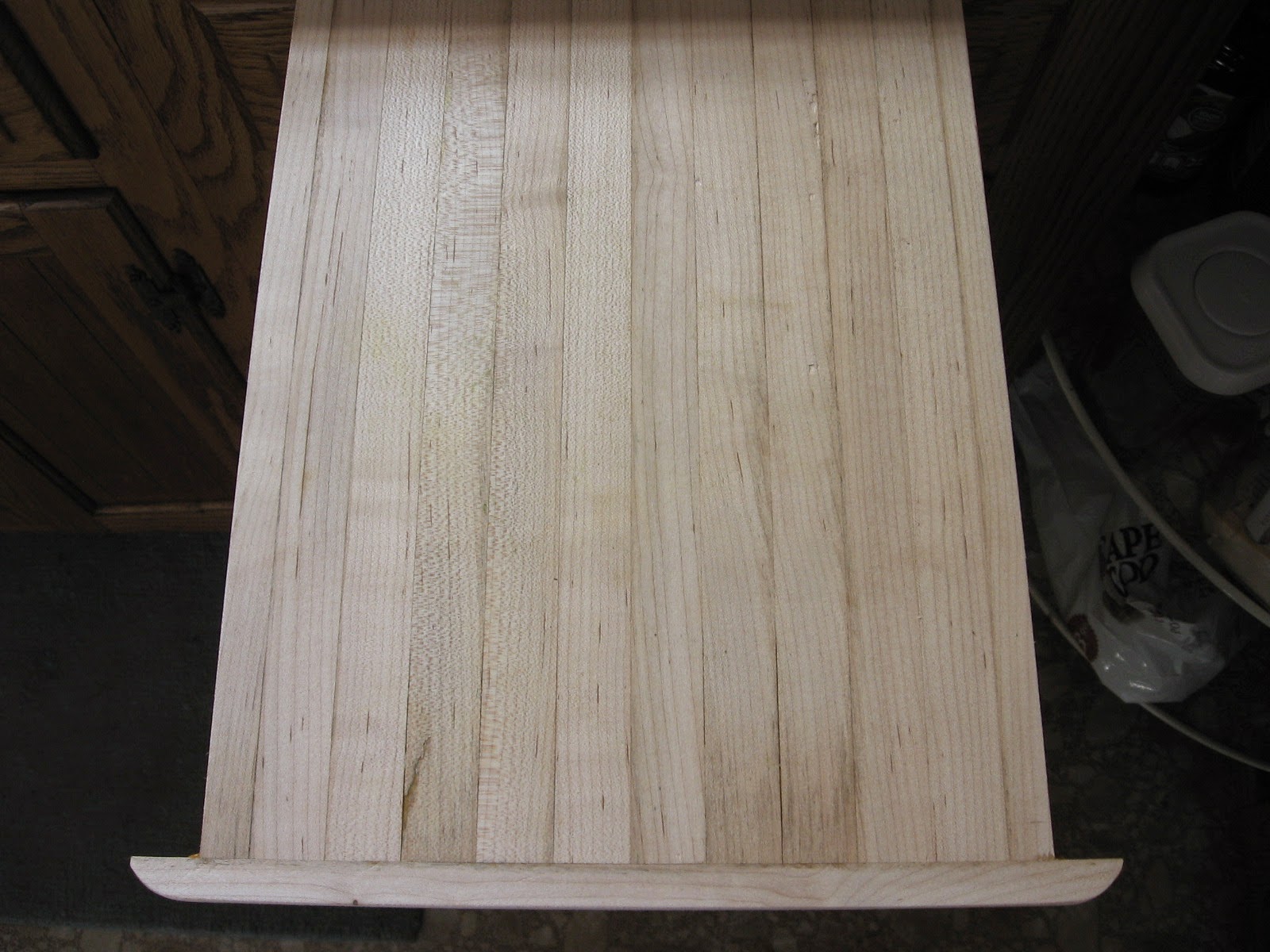 Roger also helped us make the cutting board shown above. It's the slide-out type that fits right into the cabinet face. The old one, along with all the other cabinets and hardware, was nasty. Naomi did most of the work, under the guidance of Roger. I helped out here and there. It came out really nice, and I learned a lot about woodworking, although it probably doesn't scratch the surface of what there is to know.
Over the weekend, while attempting to transplant some root crowns of comfrey, my shovel was impeded by something metallic under the soil surface. With the help of Naomi, I finally unearthed what was the iron frame of an old piano. It looks like I was digging in Ted's old burn pile. The piano frame is now leaning up against the pile of old cinderblocks on the bank of the brook.


 | |
| Fabio and his harem |
I assisted Naomi in digging some potatoes at the big garden at our old apartment a week ago today. That would've been the 5th of August. The potatoes in question were Yukon Gold. From about a dozen plants, we got just over 11 lbs! The vines were already dead, and Naomi wanted some potatoes, so we dug 'em up! The potatoes were fist-sized, yellow with a slight red blush, and were mostly concentrated right under the vine, and not spread out from the plant. They're delicious. I had previously thought that this particular variety hadn't been performing that well, but they're probably just an early- maturing variety. I could look it up, but haven't. The first potatoes of summer is a joyous occasion!
 |
| Boily, our only senior chicken |
We also dug up our garlic about 3 weeks ago now. Most of it was growing under a canopy of jewelweed, was mulched too lightly, and just overall didn't perform well. Due to the weed canopy, we didn't do an effective job of picking the scapes, and the bulbs just couldn't compete in reduced sun/ nutrient scavenging. We didn't separate the varieties at harvest, or weigh the crop. I'm going to order all new seed to plant this fall and start over. Some of the varieties we had been growing were never great producers or storers, so we'll try again, but with less varieties this time. We had about 12 different varieties until now.
We've been putting the chickens to work, as well as ourselves. I think I speak for us both when I say that we really want a lot of this grass gone, or at least transformed into something more useful. We especially need more garden beds for next spring, when I hope to have a lot of our favorite foods back in action in our lives and our landscape. There are at least 3 brush/ wood piles on the property that we've found, and we've been mining one for it's accumulated leaf litter, and subsequent black gold that's resulted as a by-product of its buildup under a pile of brush. The tricky part is that japanese knotweed has managed to begin colonizing the pile, so we sift carefully before transferring this basically free organic matter to our newly- turned beds. So far, we've got two beds in addition to our tomato garden. One is a nursery, where we're overwintering various plants until we find more suitable locations for them next year. The other one has been seeded with fall greens, which have already begun to germinate!
Naomi's been mad-scientisting some sort of budding duckponics system. We bought some (not cheap!) native waterplants to act as a biofilter for Penelope's duck pond. We need a more reliable pumping system, but the whole thing has some promise to it.
Our brother-in-law, Roger, has been helping us with a variety of tasks lately. If Mr. Rogers had the woodworking skills of Ron Swanson, you'd have a Roger. He came by while we weren't home to drop off a bridge that he made for us in order to cross the smaller stream in back. This happened to come just in time, because I started slashing lots and lots of japanese knotweed, which is starting to flower. I definitely don't want that setting seed around here. The bridge now leads to an area we call "the goat pen." It's a formerly fenced-in area across the little stream that looks like it might once have been a vegetable garden. I say formerly because the fence is still there, but has mostly been knocked down or otherwise interred by leaves and debris from who-knows how many years of dead knotweed parts. We thought it'd be a great place for goats- assuming the fence is goat-proofed because they could eat all the knotweed they want, and hopefully suppress it's devil's-dick shoots in the spring by trampling and nibbling.
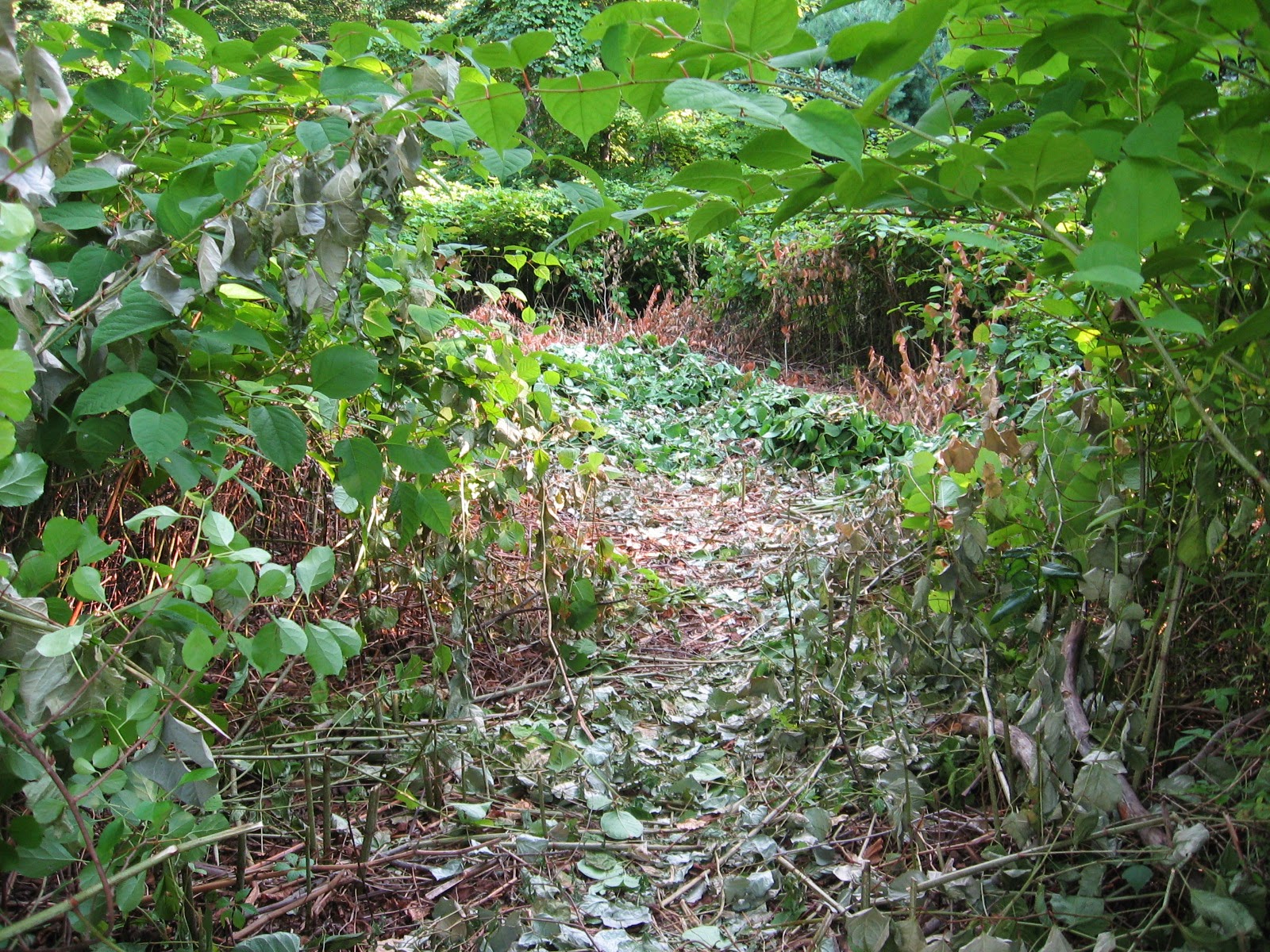 |
| inside the Goat Pen. I still have a lot to clear out! |
Over the weekend, while attempting to transplant some root crowns of comfrey, my shovel was impeded by something metallic under the soil surface. With the help of Naomi, I finally unearthed what was the iron frame of an old piano. It looks like I was digging in Ted's old burn pile. The piano frame is now leaning up against the pile of old cinderblocks on the bank of the brook.
 |
| Knotweed-slashing progress |
 |
| and finally, a picture of Ms. Penelope! |
Monday, June 4, 2012
Never Quite Caught Up
This weekend was a busy one. We got two inches of rain, but it was either fast-moving, or happened overnight, so I was able to work quite a bit still. The biggest thing that I got done this weekend was to mulch my potatoes. I hilled them with composted manure last week, and just now got around to mulching them. I use waste hay, because it's available in large quantity, and it's dumped to compost in extreme proximity to the garden.
In previous years, we've tried growing potatoes in a trench and filling in dirt as the plants grew, but we've had limited success with this method. The benefit of that is that extra material is not needed to hill around the plants. You simply use what was dug out of the trench to backfill. Two years ago, my father tried this method and got a great yield. For the last two years, however, we have not had nearly the experience that my father has. I suspect that the flaws with this method are that we have rather heavy soil, and compaction is further encouraged by the digging and backfilling, and that by continually covering up the growing stems and foliage, the plant is weakened. Then it takes longer to recuperate before growing nice tubers. Instead, I chose to use a hilling method. I buried my seed potatoes rather shallow; maybe 2 inches deep. Once the first stems broke the surface, the plants grew vigorously! Once they had reached their full height, I began hilling around their bases. By the time I finished with the hay mulch yesterday, I noticed that many of the plants were blooming quite robustly, as I've never had potato plants do before. I'll have to keep my eye of the hay level over the plants because I suspect that it will compact and break down rapidly throughout the summer, potentially leaving my tubers exposed to sunlight.

Yesterday evening, I picked spinach, as it's starting to bolt. I will replace it with New Zealand Spinach in the coming days. This is a big event for me, because successfully growing spinach was #2 of my 2 garden goals this year. The first goal has yet to be accomplished, but it's a long way off anyway.

In previous years, we've tried growing potatoes in a trench and filling in dirt as the plants grew, but we've had limited success with this method. The benefit of that is that extra material is not needed to hill around the plants. You simply use what was dug out of the trench to backfill. Two years ago, my father tried this method and got a great yield. For the last two years, however, we have not had nearly the experience that my father has. I suspect that the flaws with this method are that we have rather heavy soil, and compaction is further encouraged by the digging and backfilling, and that by continually covering up the growing stems and foliage, the plant is weakened. Then it takes longer to recuperate before growing nice tubers. Instead, I chose to use a hilling method. I buried my seed potatoes rather shallow; maybe 2 inches deep. Once the first stems broke the surface, the plants grew vigorously! Once they had reached their full height, I began hilling around their bases. By the time I finished with the hay mulch yesterday, I noticed that many of the plants were blooming quite robustly, as I've never had potato plants do before. I'll have to keep my eye of the hay level over the plants because I suspect that it will compact and break down rapidly throughout the summer, potentially leaving my tubers exposed to sunlight.

Yesterday evening, I picked spinach, as it's starting to bolt. I will replace it with New Zealand Spinach in the coming days. This is a big event for me, because successfully growing spinach was #2 of my 2 garden goals this year. The first goal has yet to be accomplished, but it's a long way off anyway.

Washed and ready to eat!
I've always had trouble germinating spinach, and it's because I didn't understand the plant. Usually I attempted to start it with my other brassicas, under moist, light, and relatively warm conditions. This was a mistake. This year, I did a little research. I soaked the spinach seeds in water for 24 hours, and then put the seeds into plastic baggies with a wet paper towel, and then put that in the refrigerator until I saw their little white shoots coming out. At that point, I probably could have set them in the garden to do their thing, but I wanted to keep a closer eye on them, so I arranged them in a flat tray and put it under lights in my living room until they had real leaves. Then I set them out in the garden. All of this happened late in the season of course, but I'm happy to have had a success!
Sunday, May 20, 2012
Sprung


First of all, we're implementing a more effective wide-row system this year. I actually dug out paths between the beds and used that soil to create raised beds. This garden plot has a tendency to flood or hold water in heavy rains because it's so close to the river, and the soil is very silty. So far, these beds and low paths in between have helped irrigate water on their own. Last year I tried to make wide beds, but didn't implement it well enough.
In the second picture- this year's picture, dead ahead you can see a strip of green. This is annual rye grass and clover. I planted it between a few of the rows to suppress weeds, hold moisture, create biomass for mulching, habitat for insects and animals, and beautify the garden so it would look like one lush green mat. There is much more planted in the garden than it looks from the picture. Off to the far left is where most of the action is. There's a ton of garlic over there, as well as some peas. The potatoes have really shot up in the last 2 weeks too. I need to find time to hill some soil on them, as it's about that time. Previously, I've tried starting the potatoes in a trench, and filling in the trench as the plants grow. The problem that I found with this is that our soil is much too dense for that, and leads to further compaction, which of course the growing tubers don't like. So, this year we're going to hill them.
Radishes are coming up, as well as corn and beets. The jerusalem artichokes are coming up very very fast. I hope that I like them, because I think we're going to have them for years to come. Our spinach is coming along, despite the warm weather we've been enjoying. The weeds are starting to overgrow the onions, but I started to remedy that today, and should finish in the next day or two after work rain or shine. I still have quite a bit to plant, but it will happen as I can get around to it. Sunflowers are coming up, and the wheat is starting to get going finally, too. Hopefully in the next week or so, I'll get around to describing in more detail about the specifics of starting some of these plants.
As Naomi and I were weeding this morning, I was moving around some wooden boards that I haven't made into tripods yet, and I dropped a whole stack of them making a loud CRACK sound. Instantly, I heard a turkey gobble in response, so I pushed over another stack of boards with the same result. I had the camera with me, so I crouched down and headed in the direction of the sound- the river bank. I looked across the river, and there he was...

Subscribe to:
Posts (Atom)